What is orbital welding

Orbital
welding

The best process
for perfect tube joints

What is
orbital welding?

Products for orbital welding

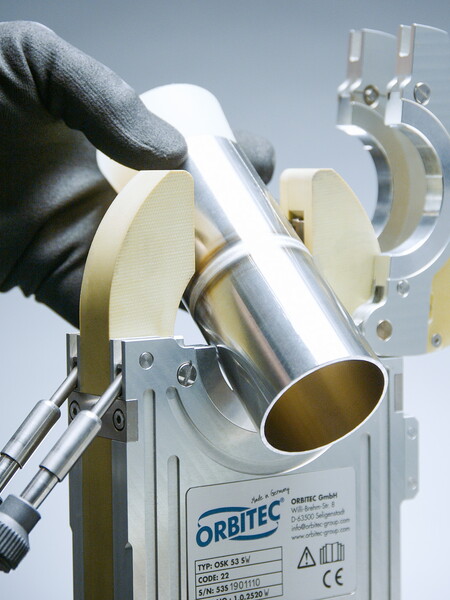
For orbital welding, the welding head rotates 360° around the part to be welded. During the welding process, the arc moves around a fixed tube or formed tube section on a circular path (orbit). Orbital welding is used in particular for metalworking and tube systems / pipework.


Tube welding is differentiated by two main characteristics:

Orbital welding with an enclosed welding head

In a closed chamber system, orbital welding is carried out using orbital welding heads in an inert gas chamber. This can be used for welding parts with a max. wall thickness of up to 3.0 mm to the base material with an I-joint, without any filler.


  • Tube diameter from 3.17 mm to 168.3 mm
  • Wall thickness up to 3 mm
  • Welding without fillers

Orbital welding with an open welding head

Open welding heads can be used to weld thin-walled or thick-walled tubes, optionally with filler wire. The heads can be clamped continuously, allowing for greater flexibility.


  • Tube diameters from 8.8 – 273.0 mm
  • Wall thickness up to approx. 6 – 7 mm
  • Welding with and without filler

In which areas are orbital welding systems used?

  • Tube-to-tube joints
  • Tube-to-tubesheet joints
  • Tube-to-fitting joints

Areas of application

Orbital welding is used in the following industries and sectors, to name a few:


semiconductors, aerospace, pharmaceuticals, chemicals, food and beverage, shipbuilding, boilers and heat exchangers, oil and gas, petrochemicals and renewable energies.


There are also many other industrial applications where only orbital welding technology meets the necessary quality requirements.

What is special about orbital welding?

Pipe weld seam

The special features of orbital welding are the extremely high quality of the welds, reproducibility and documentability. Orbital welding is therefore used wherever a high quality of the welds is required.

Thanks to modern technology, high-quality welds can be produced even in tight spaces. The welds are flat, reproducible and absolutely even and have a low roughness, and are therefore popular and required for sensitive applications.

The pulse technology used, combined with state-of-the-art inverter and controller technology, enables control of the weld pool in all positions.

Process monitoring during orbital welding

Modular Orbital Welding System

For process monitoring to industry standard 4.0, a powerful process controller and appropriate monitoring devices are used to execute a reliably reproducible tube welding process, including comprehensive process documentation.

The controller has a simple and very clear structure to enable intuitive and clear programming. Operator training to DIN EN ISO 14732 (3 training days) qualifies operators to carry out complex and challenging welding processes.

EVO orbital welding controller with water cooling unit including a 200-A power source. This controller can also be used without a water cooling unit if gas-cooled welding tools are used.

To increase productivity, a Switchbox can be used to weld with two alternating welding tools with a single controller.

TIG orbital welding

Orbital Weld Head in Horizontal Position

TIG orbital welding is a special type of TIG (tungsten inert gas) welding.

The main difference is the partial mechanisation of the process. Different types of welding tools, e.g. the orbital welding head, hold the tungsten electrode or TIG torch.

Questions and Answers About Orbital Welding

Yes. Automated orbital welding significantly increases productivity because the process is consistent, repeatable, and faster than manual TIG welding. Automated systems operate continuously, are less prone to errors, and allow previously defined welding programs to be reused as often as required with identical quality. This reduces rework and scrap while noticeably shortening production lead times.

In TIG orbital welding, a non-consumable tungsten electrode is used under shielding gas to produce high-quality weld seams. Orbital welding is the automated version of this process, in which the welding torch is mechanically guided around a stationary tube. This results in highly reproducible, clean, and uniform welds.

Orbital welding can be used for nearly all common tube materials, including:

  • Stainless steel
  • Titanium
  • Nickel-based alloys
  • Copper
  • Aluminium and certain alloys

The choice of material influences parameters such as current type, heat input, and shielding gas selection.

Automated orbital welding delivers consistently high and reproducible weld quality, which is essential for meeting the strict regulatory requirements of the pharmaceutical industry. The enclosed, low-contamination process enhances hygiene and complies with demanding cleanliness standards. Thanks to flexible and quickly adjustable parameters, different tube dimensions can be manufactured efficiently, making the process ideal for frequent product changeovers. The technology also enables higher process speeds, lower costs, and greater safety, as critical process steps are automated.

Scrap can primarily be reduced through proper material preparation, correctly configured orbital welding parameters, and regular quality inspections. Well-maintained equipment and properly trained personnel also make a significant contribution to process stability.

Orbitec supports customers with expert advice throughout the sales process. We analyze your specific requirements, recommend suitable orbital welding systems and welding parameters, and help you achieve stable, reproducible weld seams with minimal scrap right from the start.

Yes, orbital welding can also be worthwhile for small production runs, especially when consistent quality, cleanliness, and reproducible results are required. The process offers clear advantages for tube welding, even with lower production volumes.

However, whether it is economically viable depends on factors such as your materials, tube dimensions, quality requirements, and production processes.

Orbitec provides individual support in evaluating your application. We assess your requirements, recommend the appropriate orbital welding technology, and help determine whether implementing orbital welding will be cost-effective in your specific case.

Thin-walled tubes are highly sensitive to heat input, making proper preparation, precise heat control, and correctly configured welding parameters essential. Low welding currents, consistent travel speeds, and controlled cooling help minimize unwanted distortion.

To provide additional stability, Orbitec offers specialized orbital weld heads designed to clamp thin-walled tubes without introducing mechanical stress. These systems ensure even heat distribution and reduce thermal loading during the orbital welding process. As a result, tubes retain their roundness and clean, low-distortion welds are achieved.

When welding galvanized tubes, it is important to remove the zinc coating in the weld area, as it can otherwise cause evaporation, porosity, and weld quality issues. After cleaning, the welding parameters (current, travel speed, and gas flow) must be precisely adjusted to the material and wall thickness to achieve a clean and stable weld.

After welding, the weld seam should be visually inspected, and corrosion protection should be restored using zinc-rich paint or zinc spray.

Because zinc fumes may be generated during welding, adequate ventilation and appropriate personal protective equipment are essential.

In confined installation environments, it is essential to prepare the tubes carefully, align them precisely, and use an orbital welding machine with the correct welding parameters.

For such applications, compact and slim orbital weld heads are particularly suitable, as they are specifically designed for hard-to-reach areas. Orbitec offers a wide range of small, lightweight, and flexible orbital weld heads that can be positioned safely even in very limited spaces while ensuring a uniform and reproducible weld seam.

Trial runs and a brief visual inspection after welding provide additional process reliability and help ensure consistent results, even under challenging installation conditions.

When performing orbital welding in a cleanroom, the primary requirements are particle-free conditions, clean materials, and low-contamination processes. This includes the use of an appropriate cleanroom classification, thorough cleaning of all components, orbital welding systems designed for low particle generation, and the use of cleanroom garments. Automated welding processes further help minimize human influence and reduce particle contamination.

Orbitec supports companies with comprehensive consulting services, extensive industry experience, and numerous successfully completed cleanroom projects. This enables the precise selection of equipment configurations, materials, and process steps that are tailored to specific cleanroom requirements.

Successful integration requires a detailed process analysis, the selection of suitable orbital welding systems, seamless integration into existing automation equipment such as robots and transfer systems, and precise control and parameter settings. In addition, quality control measures and comprehensive documentation should be incorporated into the production line.

Orbitec supports this process through experienced application engineers who assess existing production workflows directly on-site, recommend suitable equipment configurations, and develop the optimal integration concept for the automation environment. This ensures that orbital welding is incorporated into the production line seamlessly, reliably, and with maximum process stability.

Automated orbital welding reduces costs through lower labor requirements, higher productivity, and significantly reduced scrap rates. The precise and reproducible process control minimizes expensive rework and material waste. In addition, orbital welding systems can be scaled easily, allowing increased production demands to be met without the need to add substantial manual welding capacity. Overall, this results in stable, predictable processes and sustainably lower production costs.

All products and accessories

Products for orbital welding

Modern orbital welding solutions are needed in many applications. The superior quality of these solutions and the weld quality make the use of these systems an absolute must in many industrial applications. Orbitec offers a variety of different orbital welding systems, in modular or compact versions, tailored to suit different industry sectors and requirements. Almost all welding heads for orbital welding are available from Orbitec with gas-cooling or water-cooling.

Welding tools and welding accessories in practical application

After some initial insights into the orbital welding process, we introduce you to our products in additional videos. This includes auxiliary tools such as turntables, which are shown in practical application.

Would you like more information?
Don’t hesitate to contact us.

+49 6182 / 78693-0
info@orbitec-group.com

Orbitec GmbH
Im Mittelfeld 2
D-63500 Seligenstadt
Germany