Oxygen analysers

Oxygen analysers from Orbitec: the first step to a perfect weld

Absolute accuracy. Easy to use.

  • Guaranteed low level of tempering colours
  • Fast reaction times
  • High measuring accuracy
  • Easy to use
  • Measuring of inert gases and gases with H2 content
  • Indispensable for first-rate quality

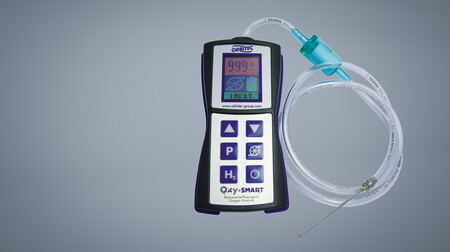
Compact, handy residual oxygen meter for mobile use. With robust rubber protection frame, ideal for construction sites.

Open product

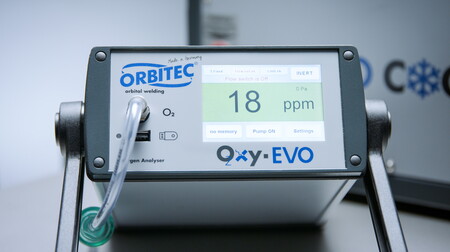
Measures oxygen content inside the tube before and during welding, with adjustable switch and alarm values. Optional differential pressure module for precise purge gas pressure documentation.

Open product
Weld seam with different residual oxygen levels

Purging

Proper purging is absolutely essential to guarantee high-quality welding of high-alloyed, corrosion-resistant components. Our Oxy EVO oxygen analyser can be connected to our orbital welding controllers for the purpose of inspecting and documenting the residual oxygen content and evaluated. You are free to choose the value in ppm entered in the controller.

Unless specified otherwise, a value < 30 ppm is generally sufficient for starting welding. The controller will not allow welding to commence until the measured value drops below the entered value. The equipment is calibrated so that it measures with an accuracy of +/- 2 ppm in the welding-related area below 30 ppm in the case of inert gases.

Analysers that display values as percentages are not recommended ➝ 0.1% = 1,000 ppm!

Questions and Answers About Measuring Residual Oxygen in Orbital Welding

Residual oxygen is the oxygen that remains inside a pipe or vessel after purging. Since oxygen reacts with the material at high temperatures, it can significantly affect weld quality.

Especially when performing orbital welding on stainless steel, high-alloy materials, or high-purity process piping, keeping the oxygen content as low as possible is essential for achieving a clean weld root and high corrosion resistance.

Analysing residual oxygen provides assurance before welding begins. Without analysing the oxygen level, it is not possible to reliably determine whether the purging gas has already displaced the oxygen sufficiently.


Analysing residual oxygen helps to:

  • avoid welding defects
  • reduce heat tint
  • minimise scrap and rework
  • achieve reproducible results
  • reliably meet quality requirements


Especially in industries with high quality standards, analysing residual oxygen is therefore an important part of process control and documentation.

For the measurement, a sample of the purging gas is taken from inside the pipe and fed to the measuring device. The device analyzes the oxygen content and typically displays the value in ppm (Parts per Million). As soon as the specified target value is reached, the welding process can be started. Modern systems such as the OXY EVO residual oxygen measuring device from Orbitec even enable automatic approval of the start of welding based on the measured oxygen value.

The measurement is carried out during purging and immediately before the start of welding. For particularly demanding applications, such as orbital welding of piping systems in the pharmaceutical or semiconductor industries, the oxygen content can also be monitored during the welding process. In such cases, the Oxy EVO + PPA residual oxygen measuring device from Orbitec can continuously measure the oxygen content inside the pipe and transmit the values directly to the orbital control unit. If the defined limit value is exceeded, this is detected, documented and, if required, immediately incorporated into the process. This ensures consistently high weld quality, even in critical applications.

In orbital welding, very small amounts of oxygen are crucial for weld quality. Percentage values are often too imprecise for this purpose. For example:

  • 0.1% oxygen = 1,000 ppm
  • 0.01% oxygen = 100 ppm


Since values well below 100 ppm are often relevant in welding, the specification in ppm has become the industry standard.

The required limit value depends on the material, application and quality requirements. For many applications in pipeline construction, a value below 30 ppm is considered sufficient for starting the welding process. In sensitive areas such as pharmaceutical systems, semiconductor installations or high-purity process systems, even lower values are sometimes required.


The limit value of 30 ppm has become established as a practical guideline in many high-quality welding applications. At higher oxygen concentrations, the risk of:

  • oxidation of the root side
  • increased heat tint
  • reduced corrosion resistance
  • additional cleaning effort

increases. For this reason, in many companies the welding process is only approved once the defined ppm value has been fallen below. With Orbitec's EVO orbital control units, the approval value can be set individually.

If there is too much oxygen inside the pipe, it reacts with the heated material. Possible consequences:

  • discoloration of the weld
  • oxide layers on the root side
  • reduced corrosion resistance
  • extensive rework
  • rejection of components


This is particularly critical for products with high purity requirements.

Heat tint colors are caused by oxidation of the material at high temperatures. The more oxygen is present during welding, the more pronounced the discoloration can become. The colors range from light yellow to dark blue and black tones and are often used as an indicator of the quality of the shielding gas atmosphere.

The time required to reach the desired oxygen level is influenced by, among other things:

  • pipe diameter
  • pipe length
  • number of bends and branches
  • system tightness
  • position of the gas inlet and outlet
  • flow rate of the purging gas

Therefore, identical purging times can lead to completely different results in different systems.

Many companies work with empirical values and fixed purging times. However, these do not take the actual process conditions into account. By contrast, residual oxygen measurement, as carried out with Orbitec devices, shows the actual conditions inside the pipe and enables a reliable decision on when to start welding. This helps reduce quality risks while simultaneously avoiding unnecessary waiting times.

Without analysing the oxygen level, purging is often carried out for longer than necessary. By continuously monitoring the oxygen level, the welding process can be started immediately after the target value has been reached. This makes it possible to:

  • reduce purging times
  • reduce argon consumption
  • lower process costs
  • increase productivity

Particularly in series production, this can result in considerable savings.

Analysing residual oxygen is particularly important for:

  • stainless steel
  • duplex steels
  • super duplex steels
  • titanium
  • nickel-based alloys

The higher the requirements for corrosion resistance and surface quality, the more important it becomes to control the oxygen content.

Analysing residual oxygen is particularly important wherever high-quality pipe connections are required:

  • Pharmaceutical Industry
  • Biotechnology
  • Food Industry
  • Beverage Industry
  • Chemical Plant Engineering
  • Semiconductor Industry
  • High-Purity Gas Supply
  • Energy and Power Plant Technology

In these industries, the focus is on reproducible and documentable processes.

In many projects, welding processes must be documented in a traceable manner. Recording oxygen levels provides:

  • proof for customers
  • support during audits
  • traceability of production
  • greater process reliability

Digital measurement records significantly simplify quality assurance.

An oxygen analyser for welding is particularly worthwhile when:

  • high-quality stainless steels are being processed
  • scrap costs need to be reduced
  • quality documentation is required
  • purging gas consumption should be reduced
  • recurring welding tasks are being performed

Even a small number of avoided rework operations can economically justify the investment.

Portable oxygen analysers for welding, such as the OXY-Smart, are particularly suitable for:

  • construction sites
  • pipeline installations
  • service operations
  • maintenance work

They enable direct quality control on site and reduce additional transport and inspection efforts.

Besides the oxygen content, the purging gas pressure also influences the quality of the weld root. Combined monitoring is particularly recommended for:

  • thin-walled pipes
  • small pipe diameters
  • automated welding processes
  • applications requiring documentation

By monitoring both parameters, stable and reproducible welding results can be achieved. The OXY EVO + PPA solution from Orbitec was specifically developed for this combined monitoring.

Matching products

Whether as an addition or an alternative – these products fit perfectly with your selection and expand your options.

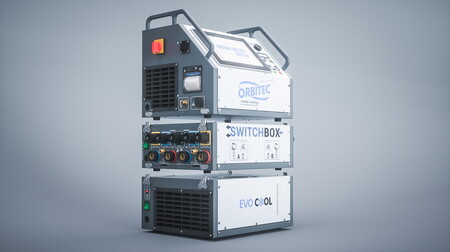
Orbital welding is complex – our orbital welding systems make it simple. Whether compact or modular, we offer solutions for every requirement and every industry. Enter the world of orbital welding technology – innovative, precise, efficient. Learn more.

Open category

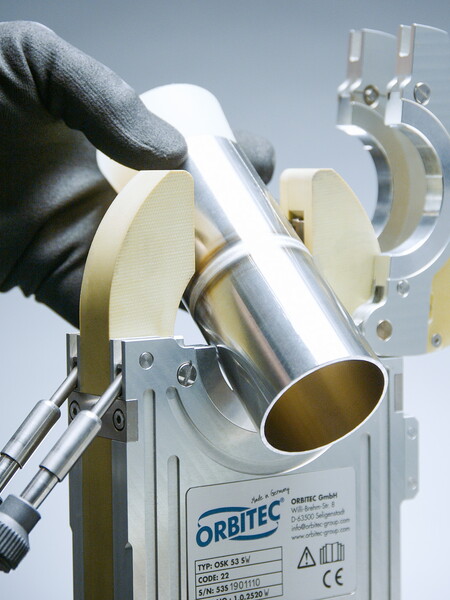
Clever, flexible and absolutely precise: At Orbitec you receive every welding technology instrument in the highest quality. Tools such as orbital weld heads and orbital welding tongs also impress with their precision. The wide range of product variants ensures the right instrument for every requirement.

Open category

Would you like more information?
Don’t hesitate to contact us.

+49 6182 / 78693-0
info@orbitec-group.com

Orbitec GmbH
Im Mittelfeld 2
D-63500 Seligenstadt
Germany