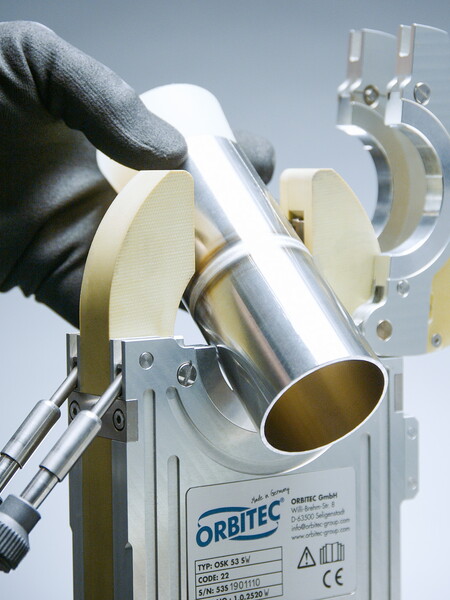

Quick change meets precision
The TURN 230 S turntable features a quick change system that enables efficient processing of components with different tube diameters. The continuously swivelling arm and the hollow shaft, through which the inside of the component can be purged via the central axis, enable processing at the highest level. Its flexible adjustment options make the turntable the right solution for any component.

Everything a welding turntable must be able to do
- Securely hold non-standard components
- Rotate the workpiece around the torch for even distribution of welding energy and melt
- Precisely align the TIG torch with the component
- Process multiple workpieces with the same setup: high production speed with reduced welding defects
- Easy operation and high flexibility
- Robust and durable for industrial use

TURN 230 S turntable
Turn table, especially suitable for orbital components with higher quantities and can be connected to all Orbitec controllers.
Scope of application:
- Tube size range: OD 10 – 230 mm | 0.393 – 9.055"
- Max. load in horizontal position: 50 kg
Technical Data:
- Chuck: Three-jaw chuck with axis adjustment
- Swivel range: 0 – 90° stepless
- Power transmission: max. 300 A
- Weight: 88 kg
- Dimensions (L x W x H): 1.020 x 360 x 750 mm
Package includes:
- Turn table
- Three-jaw chuck
- Interchangeable jaws
- Chuck key
- Robust articulated arm with central mechanical clamping
- Ground cable
- Interconnection cable with wire and AVC outlet
Special versions available on request:
- Pneumatic torch adjustment
- Pneumatic centring and clamping
- Pneumatic tailstock
- Special diameters up to 1.000 mm
- Special lengths and complete workstation equipment available on request
- Special torch consumables
Item number: 1.2.1858
Accessories and extensions
To meet the high demands of orbital welding, we offer customized adaptations and various upgrade kits for the welding turntable TURN 230 S. On request, the torch can be mounted using a manual adjustment unit. Alternatively, the torch distance can be automatically set and adjusted via an arc voltage control (AVC). In addition, a cold wire feeder with different wire consoles can be integrated.
TURN 230 S machine torch with hose package 4 m
gas-cooled, equipped with torch consumables and tungsten electrode Ø 2.4 mm
ED: AC: 105 A, DC: 220 A, 60% (10 min.)
Special lengths and versions with a higher ED available on request.
Item number: 1.2.1814
TURN 230 S machine torch with hose package 4 m
gas-cooled, equipped with torch consumables and tungsten electrode Ø 2.4 mm
ED: AC: 105 A, DC:150 A, 60% (10 min.)
Special lengths and versions with a higher ED available on request.
Item number: 1.2.1814

Manual adjustment unit for TURN 230 S using cross support
Slide width 50 mm, torch travel 50 mm, lateral adjustment 30 mm incl. torch clamp OD 20 mm incl. mounting flange
(Special torch clamp OD 30 mm available on request)
Item number: 1.2.1861

AVC unit assembly for TURN 230 S
incl. AVC motor with limit switching and 8 m connection cable, slide width 50 mm, torch travel 50 mm, lateral adjustment 30 mm incl. torch clamp OD 20 mm incl. mounting flange
(Special torch clamp OD 30 mm available on request)
Item number: 1.2.1859

Wire console for TURN 230 S
incl. wire outlet nozzle and three nozzle tips for 0.8 / 1.0 / 1.2 mm
Item number: 1.2.1852

Comfort wire console for TURN 230 S
(3D adjustable via linear unit)
Item number: 1.2.1869

Tube support for TURN 230 S
Item number: 1.2.1860

Clamp sleeve
OSW 40 CLAMP SLEEVE for torch, gas-cooled, Ø 1.6 mm, length 16 mm
Item number: 1.0.1616
Item number: 1.0.1616
OSW 40 CLAMP SLEEVE for torch, gas-cooled, Ø 2.4 mm, length 16 mm
Item number: 1.0.1623
Item number: 1.0.1623
OSW 40 CLAMP SLEEVE for torch, water-cooled, Ø 1.6 mm, length 17 mm
Item number: 1.0.1640
Item number: 1.0.1640
OSW 40 CLAMP SLEEVE for torch, water-cooled, Ø 2.4 mm, length 17 mm
Item number: 1.0.1641
Item number: 1.0.1641
OSW 80 – 275CLAMP SLEEVE, manual torch, Ø 1.6 mm
Item number: 1.0.1626
Item number: 1.0.1626
OSW 80 – 275 CLAMP SLEEVE, manual torch Ø 2.4 mm
Item number: 1.0.1627
Item number: 1.0.1627
CLAMP SLEEVE, TURN, Ø 1.6 mm
Item number: 1.0.1818
Item number: 1.0.1818
CLAMP SLEEVE, TURN, Ø 2.4 mm
Item number: 1.2.1819
Item number: 1.2.1819
CLAMP SLEEVE, RBK 60 S, Ø 2.4 mm
Item number: 1.3.3076
Item number: 1.3.3076
CLAMP SLEEVE, RBK 60 S, Ø 3.2 mm
Item number: 1.3.3089
Item number: 1.3.3089

TEFLON INSULATORS
Teflon Insulator OSW 40
Item number: 1.0.1618
Item number: 1.0.1618
Teflon Insulator OSW 80 – 275
Item number: 1.0.1629
Item number: 1.0.1629
Teflon Insulator for Glass Gas Nozzle
Item number: 1.0.1051
Item number: 1.0.1051
Teflon Insulator TURN, Hand Torch
Item number: 1.2.1820
Item number: 1.2.1820
Teflon Insulator RBK 60 S
Item number: 1.3.3078
Item number: 1.3.3078

Gas lens OSW 40 Ø 1.6 mm
Item number: 1.0.1620
Item number: 1.0.1620
Gas lens OSW 40 Ø 2.4 mm
Item number: 1.0.1624
Item number: 1.0.1624
Gas lens OSW 80-275, TURN, hand torch Ø 1.6 mm
Item number: 1.0.1631
Item number: 1.0.1631
Gas lens OSW 80-275, TURN, hand torch Ø 2.4 mm
Item number: 1.0.1632
Item number: 1.0.1632
Gas lens for glass gas nozzle OSW 80-275, TURN, Ø 2.4 mm
Item number: 1.3.1049
Item number: 1.3.1049
Gas lens RBK 60 S Ø 2.4 mm
Item number: 1.3.3079
Item number: 1.3.3079
Gas lens RBK 60 S Ø 3.2 mm
Item number: 1.3.3096
Item number: 1.3.3096

Other gas cups available on request.
OSW 40 gas cup
Item number: 1.3.1046
Item number: 1.3.1046
OSW 80 – 275 gas cup, TURN, size 8
Item number: 1.3.1146
Item number: 1.3.1146
RBK 60 S gas cup, size 7
Item number: 1.3.3077
Item number: 1.3.3077
Gas cup, manual torch, size 6
Item number: 1.3.1911
Item number: 1.3.1911

TURN ignition aid, 15 mm diameter, 150 mm long
Item number: 1.2.1803
Item number: 1.2.1803
RBK 60 S ignition aid, TURN, 16 mm diameter, 180 mm long
Item number: 1.3.3088
Item number: 1.3.3088
RBK 60 S ignition aid, TURN, 24 mm diameter, 160 mm long
Item number: 1.3.3073
Item number: 1.3.3073

AVC Upgrade Kit for Tigtronic Controllers AVC Card for DC Motors Upgrade Kit (Turn)
for Tigtronic controllers
Item number: 1.3.0031

Torch caps
OSW 40 torch cap for water-cooled torch
Item number: 1.0.1615S
Item number: 1.0.1615S
OSW torch cap
Item number: 1.3.1147
Item number: 1.3.1147
TURN torch cap
Item number: 1.2.1817
Item number: 1.2.1817
Torch cap, manual torch
Item number: 1.3.1910
Item number: 1.3.1910

GAS LENS HOLDER
for glass gas nozzle
Item number: 1.0.1050

GLASS GAS NOZZLE
OSW 80-275, TURN
Item number: 1.3.1048

BURNER WEAR PART BOX GLASS GAS NOZZLE
1 burner cap
1 clamping sleeve
1 Teflon insulator
1 gas lens
1 gas lens holder
1 glass gas nozzle
Item number: 1.0.1052

Extension hose package, 8 m, gas-cooled
Item number: 1.3.2005
Extension hose package, 8 m, combined gas and water cooling
Item number: 1.3.2006
19 items
Orbital Welding vs. Welding with a Turntable System – Questions and Answers
In orbital welding, the welding torch automatically rotates around a stationary workpiece, most commonly a tube. The welding process is fully automated and follows a predefined, reproducible sequence.
In turntable welding (or welding with a welding positioner), the torch remains in a fixed position while the workpiece rotates using a turntable or positioner. The rotation of the component allows the weld seam to be produced evenly around its entire circumference.
Both methods pursue the same goal: creating a uniform, high-quality circumferential weld. However, they achieve this using different technical principles.
In orbital welding, the workpiece remains stationary while the welding torch automatically rotates around it.
This principle is primarily used where the component cannot be moved or can only be moved with considerable effort, or where maximum process reliability is required.
Typical applications of orbital welding include:
- Thin-walled tubes
- Permanently installed piping systems
- Media-carrying systems, for example in the process, pharmaceutical, and food industries
The rotating torch offers several advantages:
- Constant welding parameters throughout the entire weld seam
- Very high weld reproducibility
- Minimal operator influence and therefore high process reliability
As a result, orbital welding is particularly suitable for serial production processes with demanding quality, documentation, and repeatability requirements, where consistent results are essential.
In turntable welding, the workpiece is rotated in a controlled manner while the welding torch remains in a fixed position.
This method is used when the component is rotationally symmetrical and can be safely clamped and rotated.
Typical applications include:
- Prefabricated components such as tubes, flanges, or cylindrical parts
- Compact assemblies and apparatus components
- Workpieces with a tube diameter from OD 10 to 230 mm and a maximum weight of 50 kg in a horizontal position, which can be securely clamped and rotated around the torch using the TURN 230 S welding positioner
The rotation of the workpiece enables:
- A uniform circumferential weld in a constant welding position
- High flexibility regarding component geometries and batch sizes
- The use of various welding processes, either manual or semi-automated
The TURN 230 S welding positioner is therefore particularly suitable for flexible manufacturing environments, single-part and small-batch production, or wherever a cost-effective alternative to fully automated orbital welding processes is required.
Advantages of orbital welding include:
- Very high repeatability
- Minimal operator influence
- Consistent and fully documentable weld quality
- Ideal for quality-critical tube welding applications
Potential disadvantages include:
- Higher initial investment costs
- Less flexibility when frequently changing component types
- More limitations regarding component sizes and geometries
Advantages of a turntable system:
- High flexibility regarding components and dimensions
- Suitable for heavy and massive workpieces
- Comparatively easy integration into existing processes
- Economical for single-part or small-batch production
Possible disadvantages:
- Greater dependence on the operator in manual processes
- Lower reproducibility compared to fully automated orbital welding systems
Component geometry is a decisive factor:
- Small, thin-walled tubes with standardized dimensions → orbital welding
- Large, heavy, or complex components → welding with a turntable system
We help you analyze the planned application at an early stage in order to select the appropriate technology.
In many industrial production environments, two different requirements exist in parallel:
- automated orbital welding for series components with high quality and documentation requirements
- flexible welding options for special or small-series components that are not suitable for orbital welding
A combination of the EVO orbital welding system and the TURN 230 S turntable system is a sensible solution when both requirements need to be covered within one production environment without using separate, independent systems.
The EVO system provides the control platform for reproducible and documentable orbital welding processes. The TURN 230 S complements this system by enabling the controlled welding of rotationally symmetrical workpieces that are not suitable for orbital welding. This allows both series production processes and special applications to be implemented using a single, consistent welding concept.
Yes. The EVO orbital welding system is designed to control different welding tools, including:
- closed orbital weld heads
- open orbital weld heads
- turntable systems such as the TURN 230 S
- tube-to-tubesheet weld heads RBK 38 S / RBK 60 S
This makes it possible to perform various welding tasks using a common control platform, simplifying operation and reducing training requirements.
By using the EVO controller, the following remain possible even in applications involving a turntable system:
- welding parameters remain traceable
- processes remain reproducible
- quality requirements can be implemented consistently
This is particularly advantageous in regulated industries or quality-critical applications, as manual and semi-automated processes can be implemented at a comparable quality level.
The combination of the EVO and the TURN 230 S is particularly suitable for companies that:
- manufacture series components and special components in parallel
- want to combine high quality requirements with flexibility
- want to use their investment as versatilely as possible
Instead of maintaining a separate system for each task, the combined setup enables a continuous welding strategy across different component types.
No. The TURN 230 S is not a replacement for orbital welding, but rather a useful complement. Orbital welding remains the preferred solution for standardized tube connections and series production processes, while the turntable system is used where orbital welding technology reaches geometric or economic limitations.
The combination enables:
- optimal utilization of the orbital welding system
- cost-effective welding of small series and special components
- avoidance of additional standalone systems
This makes it possible to combine automated quality and flexible production without creating unnecessary complexity in the production system structure.